Follow Ryan and Tricia as they plan, build, plant and care for their first garden. As chefs, they want the freshest food available, and what better way than with their own garden?

Monday, September 7, 2015

Fall garden

This weekend I ripped up the north bed and replanted fall crops. The blight had just gotten too bad and I had to make that decision to get rid of the diseased plants and get some fall lettuces going.

First off, the night before I soaked my seeds to get them germinating. I put the contents of each seed packet in a separate red solo cup and covered the seeds with water. After at least 12 hours I strained the seeds out of each cup and put them on paper towels. This helped me separate the seeds so I didn't plant them in clusters
and was able to broadcast them all over the plot.

I sectioned off the bed into four plots using cardboard pieces from canning jar boxes. I was even able to use them as labels. I did arugula, spinach, cilantro and collard greens. For these plots I just kind of threw the seeds around randomly and pushed them into the dirt. I might have to thin some of the greens, but maybe not. Last spring my mesclun mix grew close together but it worked just fine.

For the cilantro, I used seeds from our spring cilantro crop. I let it bolt, then cut the plants when they had seeded, then dried them inside. Hopefully, the seeds will be ready and actually grow something. If not, I guess we will just plant something else. Ryan and I figured we may as well try since we have a lot of coriander, more than we know what to do with anyway.

That night, after planting, a huge thunderstorm came. There was even a flood warning, but I don't think we got that much rain, maybe 2 and 1/2 inches, tops. I'm hoping my seeds weren't washed away or ruined. I think it'll be okay, but just got to wait and see.

Ryan put down some of our compost that was ready, before we planted. We had some alfalfa mulch left, too so we hand-tilled that in with the compost. The compost was kind of wet but I think it'll be ok. I only tilled down about an inch, I didn't want to go much further because we were planting crops that need to be planted shallow. And why work harder if I don't have to?

In the south bed we planted butter lettuce and bok choy. For those we planted rows since they'll grow better that way because they are more like heads of lettuce. Also, there weren't as many seeds in those packets, and the seeds were bigger than the others so it was easier to plant them in rows.

Hopefully our fall crops will do better than our summer tomatoes and peppers. Now, we just wait.

Garden Update

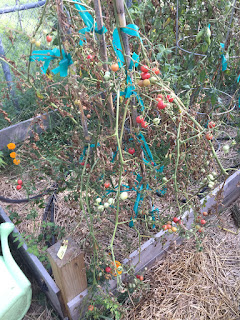
The north bed. This is the Sunpeach plant.
It's been about a month since I last posted and that's because our tomatoes aren't doing the best. This morning I ripped up the north bed, even though there was new growth and possible tomatoes to come because the blight wasn't too far behind. My logic was why wait for a few small tomatoes to hopefully ripen when I could go ahead and get started on some greens and lettuces for the fall.

Over the past month I've been trying to save these tomato plants but nothing seems to work. It's been a rainy and humid year, so the blight just spreads no matter what. I did slow it down, but then the squirrels arrived. In less than a day all of our green, almost ready to ripen tomatoes were stolen from their vines and eaten by rude, thieves. So now, there are new tomatoes beginning but their branches are full of blight and by the time they ripen they will be half rotten anyway. So I pulled the plants. It was hard to do, but something that needed to be done.

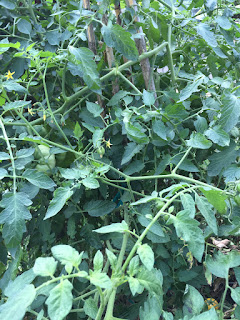
The south bed is doing a little bit better in regards to blight.
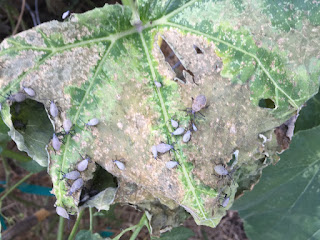
Squash bugs!
There are small amounts of it on the bottoms of the plants, but I've given up pulling those leaves. Now I've been using that Fertilome spray, which seems to affect the insects and other wildlife very minimally. I tried spraying it on some squash bugs and they seemed unbothered by it, even a few hours later. So that's a good sign, except those bugs are still there, I guess.

The butternut squash is still growing baby squash and right now we have at least eight fully grown squash we are letting age a bit on the vine so we can store them overwinter. We
South bed. 
have a minor problem with some squash bugs, but now that Ryan knows what they are and what their eggs look like (little black dots on the underside of squash leaves, usually in perfect little rows) we can combat them. But right now, our squash plant is going crazy so a few bugs won't hurt. We just can't let them get out of control.
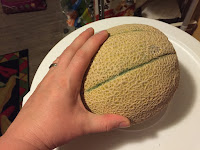
Good sized muskmelon
I picked our first cantaloupe last week. The excess rain this year helped that one right along. Our muskmelon was sweet, juicy and the texture was just perfect, not like store bought. It was a pretty good size, too. There are three or four more out on the vine, but that last one is gonna be small. That's okay though, I'm still excited for it. Sometimes smaller fruit is better.

Over the past couple weeks Ryan and I have been trying to preserve as much food as we can. My mother's friend Annie has an apple tree that her family can't pick because they have disabilities and can't go climb a ladder and pick the apples, so we do it. This year we got nine crates of apples. I am not sure what kind of apples they are, but I do know they make great apple sauce and apple butter.

I've also taken up pickling. A lady Ryan works with brought a bunch (like a LOT) of cucumbers to
work for whoever so Ryan brought them home and I pickled them. I did whole dill, spears and chips as well as some bread and butter pickles. I added some red pepper and chilis to a few of the jars in hopes those will be spicy. After the brine cooled it smelled spicy, so there is hope.

The dill recipe I found is simple and it's actually made for dilling green tomatoes but I figured it Sean Brock's Heritage, and the recipe is Dilled Green Tomatoes on page 230. If anyone is interested in this recipe, please ask. I'll send it to you.
could work on pickles, too. And it did. I pulled out a jar at a party a couple weeks ago and everyone said they were good on their pulled pork sandwiches. I plan to use them for catering in the upcoming months when we do pulled pork buffets. I think that will be a nice touch to our catering, don't you? Here's the book I got the recipe from:

So, although I've been a canning fool, none of that stuff has actually come from my own garden. Our tomatoes were stolen, the ones that weren't were killed by a nasty fungus and we haven't gotten enough of anything else to can. It's a little depressing but I feel like we will be prepared for next year. At least, as prepared as we can be!

In other news, I was on Facebook last night and saw a friend who posted a picture of a pressure cooker, never used for $50. Originally $100. I jumped on that! Brought it home last night and figured out it can be used as a cooker or a pressure canner! Steal! I can now plan a garden next year and not worry about if I have the equipment to can it all. Now I do! I think Ryan and I are going to mess around with canning beans, soup and other stuff like that. Stay tuned!


Saturday, August 8, 2015

Sad News

The blight has taken another plant. I had to get rid of the 'Sweeties' plant the other day when I noticed it wasn't producing new growth, and most of the tomatoes that were previously growing had stopped. The stems were turning brown and I decided it was time to let it go.

I sprayed the Fertilome again last Thursday. There were new blight spots but it wasn't spreading like before. It's been rainy, so I haven't been able to spray it again, but I plan to maybe do it this afternoon. The fungus has slowed down but it hasn't stopped. I think it's just a humid, rainy year and we planted our tomatoes too close together. Next year we will hopefully have better luck.

Our peach tree has exploded, on the other hand. It's giving us tender, sweet fruit that I can't get enough of. Some of them have been eaten by worms but not so bad they can't be salvaged. I'll just have to be careful and cut out the parts that are worm-eaten. Some of the ones that have fallen on the
ground had somewhat moldy pits, but I've only found a couple like that. I've read where that could be the result of too much rain, but who knows? If you do, please comment below.

I plan to can a bunch of peaches, freeze some and eat even more fresh. I may even make a peach pie or cobbler.

The tomatoes are still coming, I'm just not getting as many as I had hoped. I think that is because the plants are too close and they weren't allowed to spread out. Also, I read where pruning the plants of the suckers helps the plants focus on fruiting instead of producing leaves and stems. I didn't start doing that until later on. Also, the blight seems to be slowing down the process and I only get one good harvest from a plant before the blight takes over completely and I lose the plant.

I've lost two plants completely but two others that were affected are producing new growth. That's a good sign, I think, but I'm not sure either will give me any more tomatoes. One of those plants was the 'Black From Tula' and it had  some big, beautiful, red and blackish tomatoes but squirrels got to them. I went out to pick them and they had already been torn apart from those furry little robbers. I hope they enjoyed them! Next time I won't try to let big tomatoes like that vine-ripen.

Although we've had some problems, it's all a learning experience. I'm having a lot of fun figuring things out, researching and getting my hands dirty. I feel like I can only get better and that makes me excited for next year. I think I'm going to try to get some seeds going inside on my own this year. Ryan and I also have plans to expand our garden and spread it out a bunch. I think I'm going to move my herb garden and plant more of a variety. I love drying them and cooking with them because the flavors are much fresher that way.

I'm excited to get canning this year. Peaches will be first and I'm hoping I'll have enough tomatoes for canning. If not, I plan to get some from the farmers market or maybe friends who have too many. The families I've gotten produce from in the past had way too much rain this year and not enough luck. My mom's friend has an apple tree that will be ready in the upcoming weeks, so I'll have some apples, too. Can't wait!

Monday, July 27, 2015

Using Fertilome For Blight

I decided to use an organic fungicide to help with the blight. It was taking over every plant it touched and Ryan and I didn't want it to go any further. We decided we would rather use a fungicide than lose all of our hard work to a stupid spore. I went to Jackson's Greenhouse and asked for help.

New growth on my 'Chef's Choice' orange
tomato plants that had lots of blight
You can see where the leaves died where
they were affected with blight
The lady there directed me to a product called Fertilome. She said it wasn't organic, but I did some research and the chemicals used in the product are considered organic. She kept telling me I had a bug problem from what she could see in my photos. But, I tried telling her I had talked to a few different people about it and I'd done a lot of research and she wouldn't listen. I finally showed her my original photo of the blight and she changed her tune and said maybe she was wrong. Duh.

Well, I bought the fungicide and a pH tool. I am going to take in a cup of soil for Jackson's to test for me since they do it for free. I thought free was better than spending $20 on the kit myself, but I haven't made it back because I've been busy. I have plans to take the soil in tomorrow and I will let you know what I find out.
The butternut squash is growing along the fence quickly

When I got home, I mixed up some of the fungicide with water as the bottle directed, then put it in a spray bottle. The directions say to lightly spray the affected leaves, but not so much that the leaves drip. I lightly misted all the affected plants, and tried not to breathe in the chemicals. Although they are organic chemicals, they are still chemicals and should be treated as such.

I sprayed three days ago. The photos here are taken today, three days after the application of the fungicide. I feel like it worked. The leaves that had blight on them are now brown and shriveled, as if the fungicide killed the blight, but also killed the leaf in the process. But, the stems don't seem to look any different and there is new growth on the top of the plants. Also, the blight hasn't spread like it had been before. Last week, before the Fertilome, I noticed entire branches overcome in only a day or two. Now, it's a spot here and there and mostly on the tips of the leaves. I feel like it's been a success so far, but still have to wait and see what happens.
Coriander hanging in the basement
I was scared of using the fungicide because I read online that some bugs would die as a result. Ugh, that was my biggest hesitation in using the fungicide, but I also read that it was only in the first 24 hours that it would kill bugs, so I tried to make it so when bees were out and around, it would be the last 12 hours of the 24. So, I sprayed it on around 6 p.m. when I hardly see any bees or other bugs around. Also, I've been out to the garden and there are still tons of insects buzzing around, so it must not have done too much damage. I'm not sure, and it's hard to tell. But it is something I think about and try to affect as little as possible. I read where you can cover your plants with a sheet or some other cover for 24 hours, then remove them.

The butternut squash and the musk melon plants are doing well. The butternut has vined out and we have 2-3 small squash and one big one so far. There are a bunch of flowers, too, so it must be doing well. The muskmelon is producing, too. We have at least two melons, one of them is a bit bigger than the other. That plant is growing up the fence, too, and there are many possibilities for fruit to appear. The lakota squash isn't doing much and neither is the zucchini. Hopefully, after we get the soil tested at Jackson's, we can get those turned around.

I went ahead and harvested the coriander. Some of it was still green and seems to be taking forever to turn brown. But, some of it is brown, so I decided to cut it all and hang it downstairs and see what happens. There is so much of it, I'm sure it will be ok if it all doesn't turn brown, but from the plants I hung last week, it seems like they will all eventually turn brown. 

Now that we have a blank spot in the garden, Ryan and I are going to save the spot for fall planting. We want to do more greens and lettuces. So for the time being, we are going to leave it alone. 

Once a week I've been feeding all of the plants in the garden the seaweed fertilizer Ryan bought at Jackson's. For some reason it was hard for us to find this stuff anywhere. It's available online, but hard to find in the stores and nonexistent at stores like Lowe's or Home Depot. All they have is Miracle Grow. There are all kinds of brands, but the one we are using is called Maxicrop Liquid Seaweed. I hear that fish emulsions work just as well. Our 'Tumbling Toms' plant on our front porch was looking pretty sad and had stopped producing any fruit. I poured this on it and by the next week there were three new branches with blooms on them. It's been almost three weeks since the first time I put any on it and I've gotten 3-4 tomatoes off of it and there are even more to come. I definitely recommend getting some of this if your garden seems a little puny. This is much better than Miracle Grow, and the results are immediate. It's a little pricey, but worth the price, I think. You add one ounce to a gallon of water and I did about an ounce between the two garden beds and a quart on the 'Tumbling Toms' and the rest of my flowers on the front porch. It works on those, too, in case you're wondering.

I plan to keep using the seaweed once a week and I may spray one more time for blight. I think after that, if I continue to water carefully, I won't have to worry about the blight. At least I hope.


Handy Dandy Dehydrator

Over the weekend, I've been messing around with a food dehydrator Ryan and I bought on Amazon. We discussed it for awhile and decided that we would have plenty of tomatoes to dry and other projects we'd like to try (dried fruit, beef jerky, fruit leather, etc.), and we felt it would be a worthwhile purchase. We spent about $65 for it with free shipping.

The dehydrator we bought is electric with a fan that runs. There aren't any settings on it because we decided on a basic model since we are beginners. Of course there are more expensive ones that let you play with settings like timers and temperature control. That would be nice, but those models cost more around $200 and we just weren't ready to spend that much. One thing I like about our model is that the trays can be stacked one way for a shallow drying surface for thinly cut foods, and stacked another way for thicker cut foods, you just flip it over. That way, you don't smash your food or give too much room either.

For the first round, I kept it simple with cherry tomatoes. Later, I added basil, which didn't take very
long at all.  I cut the tomatoes in half and placed them cut side up. The tomatoes weren't too juicy so I didn't have to worry about them dripping into the fan, which is something I have to watch out for on this particular model. I didn't treat the tomatoes with anything at all, I just stuck them into the dehydrator after slicing them and turned it on.

A little bit later, I added some fresh basil from the garden. The basil only took 45 minutes to an hour. It was quick and the smell was amazing. I just stood there and smelled it all for awhile and enjoyed the aroma. When the basil was dried, I found a container and crumbled the freshly dried herb into it. Ahh, it smelled so good! The freshest dried herbs you'll ever use are ones produced this way. I opened my store-bought basil and compared and it just didn't make the cut. The store-bought stuff was gross compared to what I had just made. It's hard not to throw it out, but it's gonna happen eventually I'm sure.

Dried cherry tomatoes
Yesterday, I found some somewhat old blueberries in the fridge. They weren't yet moldy, but they were just a little shriveled. I thought, 'what the heck' and threw them in the dehydrator. Why not? I left them in for about 11 hours and they were almost all the way dry, except for the bigger blueberries, they were like little pebbles. The bigger ones were a little more like raisin-consistency.

I also dried some herbs -- thyme, basil, pineapple sage and rosemary -- but I did those first so the flavor wouldn't leach out into the blueberries. That wouldn't be good.

Next, we want to try bananas, peaches and maybe even some kiwi.

Wednesday, July 22, 2015

Our Struggles With Blight

So the blight did not go away.

We had to sacrifice our 'Early Girl' plant and may have to get rid of the 'Chef's Choice' orange ones. It's very sad and depressing, really. I'm scared the rest of my plants are going to get infected so we started to make some hard decisions.

The stems on my pepper plants were turning black
Blight on my pepper plants' leaves


Ryan and I decided to also get rid of our bell pepper plants and jalapeno plants because they were overcome with blight, also. The stems were even starting to turn black, which I read HERE is sign of late blight, which is even harder to get rid of and can even kill your entire crop in a matter of days. That scared me, so I wanted to rip those out as soon as I could. It was a hard decision, but we felt like it was the best one.

I've been able to prune off the small bits of blight from all my other tomato plants, but I'm scared the 'Black From Tula' may be on its way out, but it has tons of fruit on it right now. I think tomorrow I'm going to check out Jackson's Greenhouse and talk to the people who work there and see if there is something I can do. I really want to keep the garden organic, but I've read about how there are organic solutions. I was not wanting to use any chemicals, but I guess I'm gonna have to if I want to save these plants.

One of my many harvests.
In order to keep the plants from touching so much, we've started to direct each plant's growth out, away from the other plants. Now that the pepper plants are gone, we have room to walk back into the garden and mess around with the plants. Next year, we definitely need to space things out a bit more so we can do that on a regular basis. Being able to view your plants from all angles is important. One I wish I would have been told before starting this endeavor.

Overall, I'm happy with the garden. If we can get this blight under control we should have plenty of tomatoes for canning, BLTs, salads and even some to share with family and friends. Every tomato I've tasted has been amazing, and I can't wait for more. Tonight, we just cut our first 'Black From Tula' and it was juicy, meaty and robust. The 'Early Girl' tomatoes have been sweet, but smaller than I'd hoped and packed full of flavor. The 'Sunpeach' has been one of my favorites. It's peach colored and sweet, meaty and bursting with juice.

A variety of tomatoes from the garden.
The couple zucchini we've picked are flavorful and the texture has been good. But, as you can see from the photo above, the ends are kind of withered and I found where it may be blossom end rot, which occurs because of calcium deficiency. There have been a couple other zucchini where the end was more mushy and looked like it was rotting off.

I have a bunch of eggshells so I'll probably go throw those on there to start off. But first I'm going to test my soil. While I'm at Jackson's I'll ask about a soil testing kit or meter. I found that Ace Hardware has one for $15.

I ordered a food dehydrator on Amazon last week and it should be here tomorrow. We plan to dry many of our cherry and grape tomatoes with it. We have plenty for a first batch this weekend. I'll post my experience here.

Sunday, July 12, 2015

Garden Progress Mid-July

Everything is coming along nicely. I feel like the plants are much healthier after I removed the blight-filled leaves.

I did find that some sort of pest got to one of my "Black From Tulas". I looked up some possibilities, and found where it's probably a tomato hornworm. I tried looking under the leaves to find them, but couldn't. This was the same day I picked all of the leaves with blight, so maybe I was able to remove the worms, too? I hope so. I haven't seen any more holes in any other tomatoes, yet. I will keep checking.


Here are a couple more tomatoes on my "Black From Tula" plant. They look so good!


Here are some "Chef's Choice Orange" after pruning. 


Our Lakota squash is going crazy. It's found its way up our fence without much help. Ryan is trying to get the muskmelon to do the same thing in this photo. He also had to separate the Lakota squash from some of our tomato plants because the squash was just wrapping itself around the tomatoes. Next year we know to plant everything much further apart.


These are some "Sunpeach" cherry tomatoes. They are so sweet and juicy. We've been able to harvest a few of these here and there, but there are about to be hundreds.


The "Sunrise Bumblebee" is coming along nicely.


These are "Sweeties", another sweet cherry, but these will be bright red. As you can see, we are going to have hundreds of these, too.


The plant most affected by blight, the "Early Girls" are still coming along nicely. There are lots of fruit still hanging and starting to redden up a bit. I'm just hoping there will be new growth after these.


I spied this little guy while watering. I hadn't seen anything but blossoms on the zucchini plant.  There's another small one to the left of this one, but you can't see it in this picture, and it's much smaller. This one is the star of the show, at the moment. I can't wait to see how many more we get!